CSMEN Update - Special Edition: 15 years in NES
CSMEN entered NHS Education Scotland over 15 years ago as the first clinical skills network in the world. As pioneers, the path ahead of us was largely undefined however our mission was clear: to enable innovative, quality-assured skills and simulation-based learning across health and social care for Scotland, and to connect people and organisations in support of a “Once for Scotland” approach to skills and simulation-based learning.
What has been achieved since then has far exceeded our early expectations and as we once again enter a new organisational home within Public Services Delivery Scotland (PSD Scotland), we invite you to reflect over what we have been able to accomplish in this special edition of the CSMEN newsletter.
The interprofessional connections established throughout the years has shaped simulation practice across Scotland, carried us through COVID with the network being used to create the Skills Hub at the Louisa Jordan, and continues to prove itself invaluable. We are grateful for what we have been able to accomplish with our network throughout the years as part of NES and look forward to the opportunities that lie ahead in this new chapter as part of PSD Scotland.
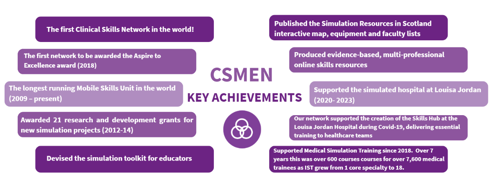
Key Achievements
Collaborations, partners and delivery units
Throughout the past fifteen years, we have worked alongside a wide range of organisations to support in the development and delivery of training programmes across Scotland. We are proud to have:
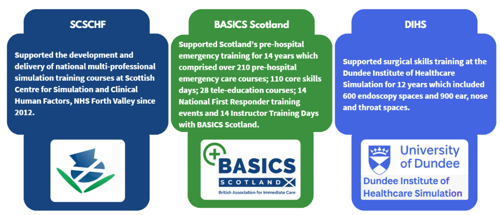
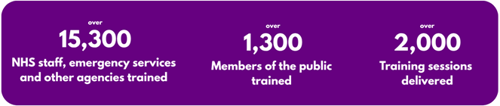
Over the last 10 years, CSMEN with the MSU, BASICS Scotland and the SCSCHF has also been able to deliver training to practitioners, in urban and remote and rural areas, who otherwise would not have access to high quality simulation education.
These partnerships represent only a few of the organisations and individuals we have had the privilege to work with and we are grateful to all the organisations, simulation champions and healthcare professionals we have had the opportunity to work alongside as part of NES and look forward to carrying the same collaborative spirit with us in PSD Scotland.
Mobile Skills Unit: 17 years of impact across Scotland
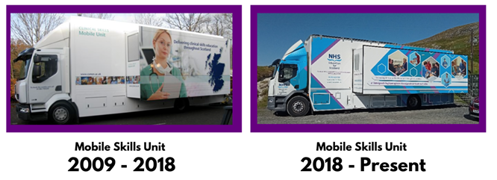
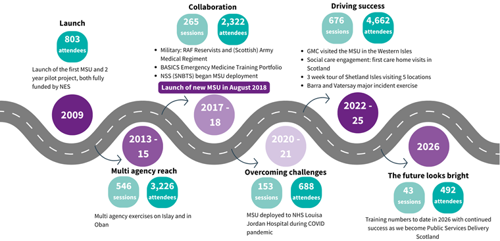
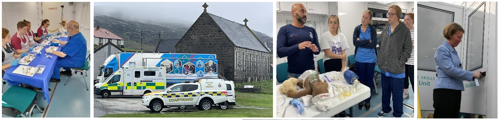
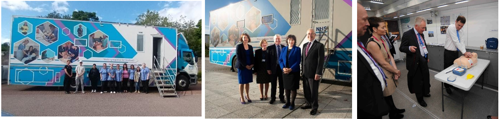
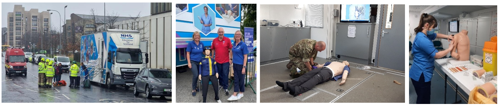
Since its launch in 2009, the Mobile Skills Unit (MSU) has transformed access to clinical skills education by bringing high-quality simulation training directly to healthcare teams, emergency responders, and communities across Scotland. Designed to overcome geographic and professional barriers, the MSU has ensured that even the most remote areas benefit from equitable learning opportunities. Training locally has strengthened teams, reduced time away from clinical duties, and contributed to significant cost and carbon savings.
The unit played a pivotal role during the COVID-19 pandemic, supporting rapid workforce training by being deployed to the NHS Louisa Jordan Hospital. More recently, in 2024, it expanded into the social care sector with its first care-home-based simulation training sessions.
Alongside major-incident exercises, multi-agency collaborations, tours of remote islands, and GMC engagement visits, the MSU has established itself as a national asset supporting Scotland’s health and care workforce.
As CSMEN moves into its new home within Public Services Delivery Scotland, the MSU’s legacy of accessibility, innovation, and partnership will continue to shape how mobile simulation-based learning is delivered in the years ahead.
To hear medical professionals from across Scotland talk about their experiences using the MSU watch our MSU testimonial film.
Online Skills Resources
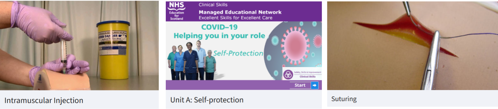
Over the years, CSMEN has developed a wide range of evidence-based, quality-assured online educational resources designed to support multi-professional clinical skills teaching across Scotland.
Currently the following online resources are available through the CSMEN TURAS page:
· Intramuscular Injection
· Intravenous Medicines Administration
· Faculty Development
· Suturing
· Urinary Catheterisation

During the pandemic CSMEN expedited the production of online COVID 19 resources for healthcare providers on subjects such as Protecting yourself and your workplace environment and Assessment and care of people with COVID-19. These resources were used over 53,000 times and archived by the National Library. In addition, interviews were undertaken through the Lockdown in the Larder series to see how the resources were being used in practice.
Simulation Resources in Scotland
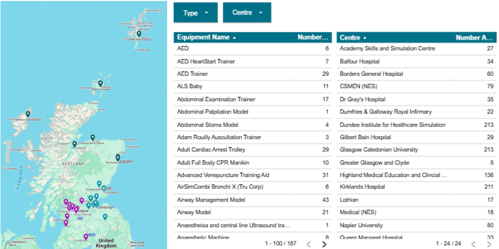
In 2023 (updated in 2024) CSMEN undertook the scoping project to determine the simulation resources (equipment and faculty) available in the health boards and universities in Scotland.
The main objective of the project was to enable the sharing of resources within and between health boards by creating a database of where the resources are in Scotland and who is responsible for them. The project had four outcomes:
· A report containing information on the simulation centres in each health board area
· An interactive map which enables searching for equipment by location
· An Excel file with equipment information
· An Excel file with course information
All these can be accessed on the CSMEN website.
The Evolution of Medical Simulation Training
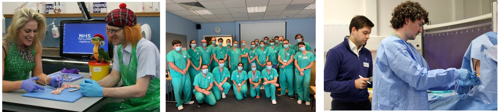
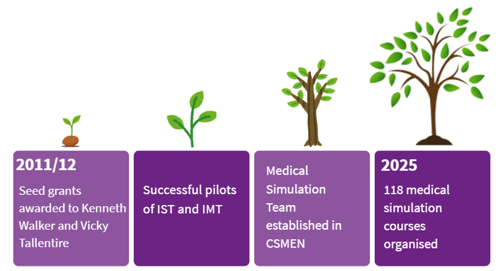
The nationally recognised Medical Simulation Training programme stemmed from an original pilot “Improve Surgical Training” supported by the Scottish Government and led by Prof Ken Walker. Ken was an early recipient of a CSMEN research and development grant in 2012 to explore technical and non-technical skills acquisition in new-start surgical trainees at the Highland Bootcamp. This Bootcamp remains a core part of the Core Surgical Training programme today.
A year later the Internal Medical Training programme was again supported by the Scottish Government to provide simulation training to IMT trainees - led by Vicky Tallentire, another early recipient of a CSMEN research and development grant.
Both programmes were supported by evidence-based research and PhD programmes resulting in a number of key publications.
Over time, this work continued to expand far beyond its origins responding to the needs of multiple specialties including:
· Core psychiatry simulation training
· Higher surgical simulation training in general surgery
· Trauma and orthopaedic surgery
· Anaesthetics, intensive care and emergency medicine
In 2025 alone, the medical simulation team coordinated 118 medical simulation courses, spanning 15 specialties and supporting over 1,300 resident doctor attendances with 2.2 million contact hours. This remarkable growth reflects not only the dedication of educators and faculty across Scotland, but the enthusiasm of trainees who recognise the value of high-quality, hands-on learning
Research and Awards

Research has been a cornerstone of our work, helping to strengthen the evidence base for simulation-based education and ensuring that our work remains grounded in best practice.
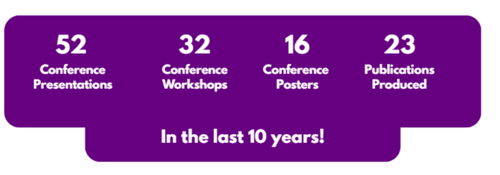
Through NES we have been able to support 21 funded research and development grants (2012-2014), enabling educators, clinicians and partners across Scotland to contribute to the national and international simulation community. We have also had the opportunity to disseminate and showcase our work at national and international conferences.
Our Clinical Lead, Catie Paton, has also contributed significantly to the educational simulation field through her work in co-editing two books released in 2024: ‘Human factors for Healthcare: A Guide for Nurses and Allied Health Professionals and Simulation-Based Education: A Practical Approach for Health and Care Educators.
The impact of this work has been recognised through several awards and commendations over the years. Highlights include:
2014: Innovation in Training Award at the Scottish Medical Education Conference
2018: The prestigious international ASPIRE Award for Excellence in Simulation from the Association for Medical Education in Europe (AMEE) for the “exemplary simulation” education delivered by CSMEN
2024: Finalists at the Scottish Care Awards
2025: Glasgow multiagency exercise shortlisted for Partnership of the Year at the Student Nursing Times Awards
These achievements highlight the breadth of our work and reflect the strength of our partnerships and collective effort that has driven innovation across Scotland.
CSMEN Hall of Fame
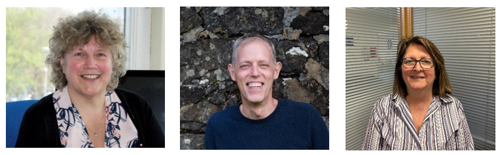
The original CSMEN team was a team of four and started at University of Dundee before moving to NES in 2011 (Jeanette Stevenson, Felicity Garvie, Sarah Race and Andrea Baker) led by Jean Ker OBE as the first clinical lead and driving force of the Network. Since then, it has gone from strength to strength to a team of nine led by Catie Paton via Michael Moneypenny who was Clinical Lead 2022-2023.
Our current team manager, Andrea Baker, has been a constant thread and guide from the outset.
The current team comprises Graeme Brown and Tim Johnson as resource developers, Lynn Hardie as the MSU Senior Officer, Sally Alho as the Simulation Team Lead supported by Karen Willey, Karis Dlodlo, Megan Hunter and Natalia Krolikowska. The team has also been growing in another way with the usual administration team of Eilidh Kimmett, Fiona Prew and Laura Urquhart currently on maternity leave.
Thanks to:
Jerry Morse (regional champion North 2009-2014)
Anna O’Neill (regional champion West 2009-2014)
Janet Skinner (regional champion East and South 2009-2014)
Catie Paton (regional champion 2011-2012)
Bryan Allan (regional champion 2011-2012)