
Dear Network Members,
A great deal of exciting work is taking place across healthcare in Scotland and in this edition we are delighted to share with you how impactful change within our healthcare systems is being driven by translational simulation. Also featured is an update on how the Mobile Skills Unit is going for Gold-standard teaching at the Commonwealth Games!
July has also marked the end of the Medical Simulation training year for which we offer a massive thanks to all who have been involved in making it a success. It has been our first month without Megan Hunter as she ventures into a new role however we are absolutely thrilled to warmly welcome Trevor Menezes who has taken over her position within CSMEN as our new Medical Simulation administrator and will be assisting with the running of several key courses over the coming months.
Translational simulation across Scotland
Translational Simulation as defined by Dr Victoria Brazil refers to “Healthcare simulation focused directly on improving patient care and healthcare systems, through diagnosing safety and performance issues and delivering simulation-based intervention, irrespective of the location, modality or content of the simulation”
In keeping with the culture of innovation and dedication toward continuous improvement that CSMEN and the Scottish simulation community is renowned for, translational simulation is already being rapidly adopted across Scotland despite being a relatively new concept. Here is how it’s being used to guide change across the country:
Scottish National Blood Transfusion Service: Translational Simulation to Explore the Efficacy of the National Transfusion Record
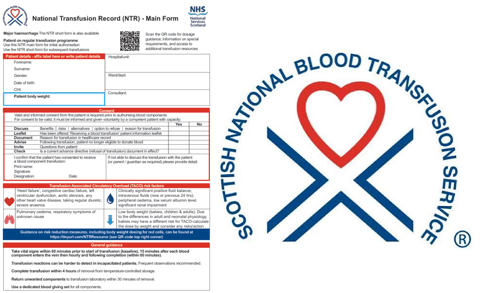
The Scottish National Blood Transfusion Service (SNBTS) Transfusion Team undertook a review, refresh and update of the National Transfusion Record (NTR) in 2025, which is utilized in every healthboard in Scotland to allow Registered Practitioners to authorise blood components for patients and record associated consent and administration details.
The team who was given this responsibility was led by Louisa Wood Transfusion Practitioner, supported by Jane Oldham Transfusion Practitioner, Jill Gardiner Transfusion Practitioner and Bryan Beattie Transfusion Support Assistant. As the project progressed it was suggested that the NTR should undergo further testing using translational simulation.
The team contacted a subject matter expert (the Director of the Scottish Centre for Simulation and Clinical Human Factors) who gave the team advice on what a translational sim was.
Jill Gardiner ran the simulation as she is also a Clinical Educator for NHS Dumfries and Galloway and has over 10 years of simulation experience. Translational simulation was used to test the NTR document, highlight its efficacy and areas for improvement when used in the clinical area. The team also gathered feedback from the staff who were involved in the simulation to ascertain if the document required further modification or if the document was ready to move to the next stage of development.
This was the first time that translation simulation had ever been used by the SNBTS Transfusion Team, and it was the first time it was utilized by the team to guide the development of a national document
Translational Simulation in NHS Shetland: Improving the Stroke Pathway through Multidisciplinary Team Learning
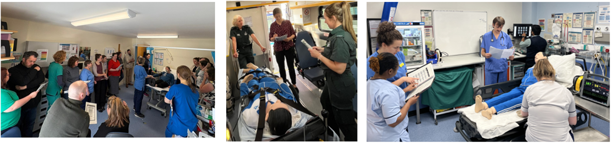
At NHS Shetland, in-situ simulation has evolved beyond traditional education and skills training to become a powerful tool for quality improvement and system redesign. Building on our established multidisciplinary simulation programme, which brings together ambulance crews, nurses, doctors and allied health professionals in their own clinical environment, we have increasingly adopted a translational simulation approach—using simulation to identify patient safety issues, test processes and strengthen patient pathways.
One recent focus has been the acute stroke pathway. Although thrombolysis is an infrequent event in a remote island setting, it is a time-critical intervention where effective coordination across multiple services is essential. Using in-situ simulation, we brought together staff from the Scottish Ambulance Service, Radiology, the Emergency Department, Medical teams and supporting services to rehearse the complete patient journey from pre-hospital assessment through to imaging, decision-making and administration of thrombolysis.
The simulations allowed teams to walk through the entire pathway in real time, testing communication processes, role clarity, equipment availability and the interface between departments. As with all translational simulation, the emphasis was not simply on individual performance but on understanding how the wider system functioned under pressure. The exercises highlighted opportunities to streamline patient flow, clarify escalation processes and improve coordination between the ambulance service and hospital teams. A similar exercise subsequently delivered in Primary Care facilitated similar conversations among the team, identifying opportunities to strengthen processes and generated further opportunities for improvement within the wider stroke pathway.
A particular strength of the programme has been the ability to gather staff from different disciplines around a shared goal and create a safe environment in which operational challenges can be explored and addressed. This aligns with the overarching aims of our simulation programme: improving communication, strengthening team working, integrating new protocols, optimising resource utilisation and enhancing patient safety.
The learning generated through these simulations has informed ongoing refinements to the stroke pathway and increased confidence among staff involved in the care of patients presenting with acute stroke. Importantly, the work has reinforced the value of simulation as a quality improvement methodology, enabling NHS Shetland to identify system issues before they affect real patients and ensuring that even low-frequency, high-risk presentations can be managed safely and effectively.
For remote and rural services, where specialist presentations may be uncommon but carry significant consequences, translational simulation provides a practical and impactful approach to improving both systems of care and patient outcomes. NHS Shetland continues to expand this work as part of its wider commitment to multidisciplinary learning, patient safety and high-quality rural healthcare.
BASICS Scotland: The use of translational simulation in pre-hospital education
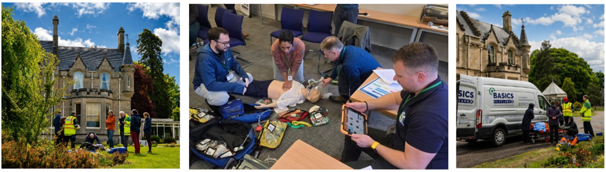
As a Scottish Charity which delivers interprofessional pre-hospital training, BASICS Scotland integrates translational simulation throughout its educational programmes to improve the quality, safety and effectiveness of prehospital emergency care and is underpinned by several key principles. Firstly, BASICS Scotland's approach is the use of simulation to evaluate healthcare systems as well as individual performance with translational simulation being embedded within the design, delivery and evaluation of our courses to ensure that learning translates directly into improved patient care. Secondly, translational simulation underpins our commitment to continual quality improvement, with the feedback from the courses analysed to identify recurring themes, educational needs and potential system vulnerabilities. Lessons learned are incorporated into course design, clinical governance processes and faculty development, ensuring that educational activities remain closely aligned with contemporary evidence, operational experience and a quest to improve patient outcomes.
For all courses the simulation scenarios delivered are developed from authentic pre-hospital cases that have been encountered by BASICS Scotland responders and are designed to replicate the clinical, environmental and human factors challenges faced in responding to emergencies in remote and rural settings. These scenarios enable clinicians to practise high-acuity, low-occurrence events, refine technical and non-technical skills, and develop effective decision-making under pressure. By embedding translational simulation into education, clinical governance and service development, BASICS Scotland creates a continuous learning system in which simulation informs practice, practice informs education, and education drives improvements in patient care. This approach supports the organisation's mission of delivering safe, effective and evidence-based pre-hospital emergency care across Scotland while strengthening team performance, organisational learning and patient safety.
Share your translational simulation work:
If you are conducting work involving translational simulation within Scotland and are interested in raising awareness to it, sharing what impact it’s making or collaborating, submissions for inclusion in our next newsletter are open to the CSMEN mailbox (CSMEN@nes.scot.nhs.uk) - include a paragraph about the work, as well as the location it’s taking place and who to get in touch with for more information (pictures are also highly encouraged).
Medical Simulation Training summary
Looking Back on a Successful Training Year
As we reach the end of the current training year, we would like to extend our thanks to everyone who has contributed to the development, delivery, and ongoing success of our medical simulation training programmes.
This year, we were delighted to welcome new Subject Matter Experts to the team. By taking on lead roles for individual courses, they have brought fresh perspectives and valuable expertise that continue to strengthen our programme.
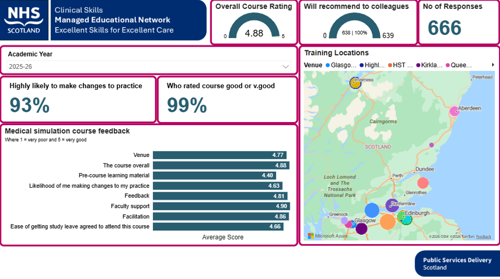
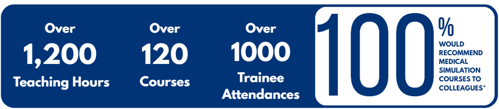
It has been another busy and productive year. We have delivered more than 120 training courses, alongside 17 monthly training days for Core Surgical Trainees. These activities have provided over 1,200 hours of teaching and supported more than 1,000 trainee attendances across our programmes.
The impact of this work is reflected in the consistently high quality of feedback received from participants. 100% of evaluation respondents said they would recommend our medical simulation courses to colleagues, while 93% reported being highly likely to make changes to their clinical practice following the training (n=666). These outcomes highlight the value of simulation-based education in supporting professional development and improving patient care.
These achievements reflect the dedication and collaborative efforts of everyone involved. Thank you for your continued support, and we look forward to building on this success in the year ahead.
MSU Update
Supporting Training in Skye
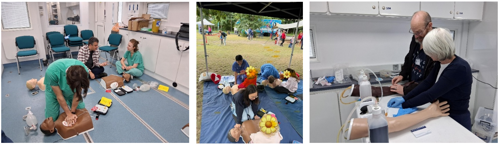
July began with a two-week Mobile Skills Unit visit to Broadford and Portree, supporting healthcare staff across Skye. Local teams delivered a range of training sessions including skills stations for ECG’s, cannulation, venepuncture and catheterisation. CPR refreshers and deteriorating patient scenarios. Feeback from participants was positive, highlighting the value of bringing education and skills training directly to remote and rural communities.
Supporting Health and Wellbeing at Glasgow 2026 Commonwealth Games Community Events
We are delighted to report the Mobile Skills Unit is playing a key role throughout late July and early August, in supporting a programme of community health and wellbeing activities linked to the Glasgow 2026 Commonwealth Games. Working in partnership with organisations including; Glasgow Life, Save a Life for Scotland, Glasgow Club, and SAMH, the MSU has been present at a variety of community events across Glasgow.
· Glasgow Club Castlemilk (23-24 July)
· Tollcross Park (25 July)
· Kelvingrove Park Commonwealth Live Site (26-28 July)
· Glasgow Club Crownpoint (29-30 July)
· Victoria Park (31 July-1 August)
The diverse programme offers members of the public opportunities to engage with CPR awareness sessions, health and wellbeing activities, physical activity programmes, family learning opportunities and community health initiatives.
These events demonstrate the flexibility of the Mobile Skills Unit and its ability to support not only workforce training but also wider public health engagement, helping connect communities with local services and promoting healthier lifestyles across Scotland.
Looking Ahead
We’re looking forward to a busy August as the Mobile Skills Unit continues to deliver training and engagement opportunities across Scotland. The month begins with a visit to Dunoon in partnership with BASICS Scotland, before the Unit returns to the Western Isles for its annual tour of Barra, Benbecula and Stornoway. A key highlight will be supporting the second Barra & Vatersay Multi-Agency Major Incident Exercise, bringing together emergency services and partner organisations to strengthen preparedness, collaboration and resilience in a remote and rural setting.
Thinking of booking the MSU for your region? Check the MSU’s calendar for available dates then complete a booking enquiry form and the MSU senior officer will get back in touch with you. For any MSU related queries, check our Frequently Asked Questions page or email nes.msu@nhs.scot!
Conferences
Scottish Simulation SIMposium 2026
Sales for the 2026 Scottish Simulation SIMposium are closing soon! The even scheduled for Thursday 20 August 2026 at the University of West Scotland will feature Dr Victoria Brazil as keynote speakers and a new “Technovation showcase”
The full agenda and tickets can be found on the Eventbrite website.
Further conference details relevant to clinical skills and simulation are available on the CSMEN website.
Scottish HPE Research Day
We are delighted to share further details for the Scottish HPE Research Day, hosted in Dundee on Wednesday 2 September 2026.
This event is organised by SCRiPT – Scottish sCholars and Researchers in healthcare Professionals educaTion – and is open to anyone involved in Health Professions Education research or scholarship in Scotland.
The day will provide opportunities for knowledge exchange, networking, discussion and collaboration across the Scottish HPE community.
Registration is now open: [registration link]
A modest fee applies to cover catering costs.
BASICS Scotland Update
Please refer to the BASICS Scotland website or all course dates.
SCSCHf Update
Please refer to the SCSCHF website for all course dates.
DIHS Update
Please refer to DIHS website for all course dates.
Please share this newsletter with colleagues as appropriate. You can sign up to join the CSMEN network and receive monthly newsletters.