
Part of our role as CSMEN is ensuring we can guide our network members toward the most relevant expertise, facilities and resources in order to advance simulation based education. Doing so requires a great deal of continued outreach efforts, networking and maintenance behind the scenes and February offered the opportunity for us to demonstrate some of the steps we take to deliver this to the community.
As part of our ongoing practice of staying connected with simulation activity across Scotland, the CSMEN team regularly visits simulation centres across Scotland to ensure we remain up to date with developments and available resources in the field. Our first visit of the year took us to Dundee Institute for Healthcare Simulation (DIHS).
Lead by Gill Keith and Neil Harrison, DIHS Co-Directors, we were given a tour of both the Clinical Skills Centre and the Surgical Skills Centre and came to understand how DIHS has become a pillar of innovation within simulation.
DIHS was the first simulation centre in Scotland to offer a simulation ward for teaching, and since then has stayed at the forefront of exemplary simulation facilitation, offering an impressive range of features and facilities, including, a theatre style anatomy teaching room, a dedicated surgical simulation suite with a Da Vinci Surgical Simulator System, as well as ultrasound and optometry equipment.
During our visit, we had the opportunity to meet a simulated patient at DIHS who shared valuable insight into their role and spoke warmly about the experience, highlighting that
A new evaluation of Scotland’s postgraduate Independent Prescribing (IP) simulation programme by NHS Education for Scotland has shown that high fidelity simulation is making a meaningful difference to optometrists’ confidence, communication, and clinical decision making.
As part of the IP pathway, optometrists participated in a structured series of simulation based clinical placement days, combining VR slit lamp training and actor-led simulated patient encounters. This immersive approach gave trainees the opportunity to manage complex and varied ocular presentations in a safe, standardised environment, something often difficult to achieve in traditional clinical placements.
Using the newly developed and validated SIMQUAL educational evaluation tool, trainees rated their expected and experienced improvements across 22 key competencies. Results demonstrated a clear positive shift:
-
Overall self rated competence increased, with the largest gains seen by the midpoint of the programme.
-
Communication and person-centred care skills improved most, with trainees highlighting the value of working with professional actors and receiving structured feedback.
-
Confidence in diagnostic reasoning and patient management strengthened, with narrowing variance in scores suggesting more consistent skill development across the cohort.
-
While technical skills such as prescribing and referral writing showed smaller perceived improvement, this was partly due to very high expectations at baseline and a ceiling effect.
Qualitative feedback reinforced the quantitative findings: participants frequently described the cases as highly realistic, the environment as supportive, and the learning as directly transferable to their clinical practice. Many reported that simulation had already changed the way they approached patient discussions and clinical decision making, evidence of early Kirkpatrick Level 3 (behaviour change) outcomes.
Overall, the evaluation highlights the growing role of simulation in Scotland’s postgraduate optometry education. By offering equitable, repeatable exposure to complex cases and fostering reflective practice, simulation is proving to be a powerful bridge between theory and independent clinical prescribing.
For further information contact: nes.optometrysimulation@nhs.scot
February has been a month of major upgrades, teamwork, and fresh new training resources for the Mobile Skills Unit (MSU) as we gear up for an incredibly busy year across the CSMEN Network.
Last week, the MSU was based at Leuchars Station beside 612 Squadron Headquarters for a full programme of manikin servicing, kit checks, and equipment maintenance. This was a huge CSMEN team effort, ensuring everything is in top condition for the year ahead.
New Clinical Skills Kit for 2026
We are excited to announce a range of new equipment now available:
Gert age and Dementia Simulation Kit
The GERT age simulation suit and dementia accessories, offer wearers the opportunity to physically experience common age-related impairments. Hosts will be able to request these items in advance so they can be added to the MSU ahead of your visit.
Venepuncture Kit
Two Adam Rouilly Venepuncture, Cannulation, Infusion & Injection Arms to enhance procedural skills training.
Wound Kit
New clinical wound packs, including stick on diabetic ulcers, pressure sores, lacerations, and puncture wounds for scenario based learning.
Manikin Overlays
Male and female facial overlays for our SimMan manikin to support more diverse simulation scenarios.
A Busy Month Ahead
The MSU is about to enter a packed period of delivery, starting with:
-
Advanced Practice Simulation training at the Golden Jubilee Hospital
-
Two days of MSU Faculty Development Course training
-
Our first-ever visit to Golspie Medical Practice and UHI Campus, where we will deliver a full week of care homes training
It promises to be an exciting and impactful month as we continue supporting high quality, accessible, public service simulation training across Scotland.
A few spaces remain in the MSU 2026 Diary - check the MSU Calendar and take a look at How to book a visit for more information.
A multi-professional collaboration (CSMEN, NES NMAHP, NHS Lanarkshire, NHS Lothian, University of Aberdeen and University of Glasgow) has developed a series of online resources to support the development of simulation educators in designing and delivering simulation scenarios.
The resource features six video presentations that explore the design and delivery processes involved in running simulation scenarios and covers:
-
Preparing and writing simulation scenarios
-
Prebriefing scenarios
-
Using the CSMEN scenario templates
-
Delivering simulated scenarios
To access the resources, click here.
Looking for more guidance as a simulation educator? Visit the CSMEN Simulation Toolbox for how-to guides, the quality assurance self-assessment tool, scenario templates and more! You can also check out our dedicated Turas Learn page for simulation educators which hosts guided learning programmes.
National Ear Care Programme
Our colleagues at NHS Academy have developed a National Ear Care (microsuction) Train the Trainer Programme for registered adult nurses working in aural care services in NHS boards in Scotland (i.e. Community Treatment and Care (CTAC), Acute ENT) who wish to become proficient as Accredited Microsuction Trainers (AMTs) for routine ear wax removal in adult ears.
-
Understanding of medico legal issues
-
Communication
-
Infection, prevention and control
-
Health, safety and risks
-
Anatomy and physiology
-
Correct use of equipment
To access the resource, click here.
The link to further information and abstract submissions for 2026 can be found here.
NES National Workforce and Education Conference 2026 – Registration open
The link for registration, further information and a download of the event programme can be found here.
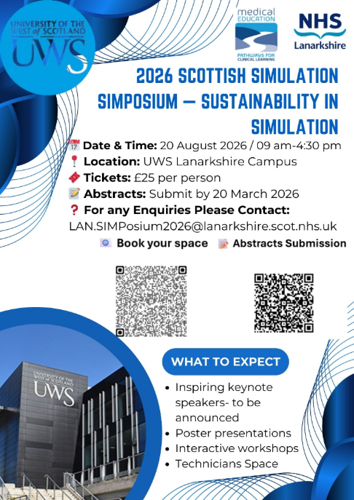
Scottish SIMposium 2026 – Registration and abstract submission now open
Tickets for the 2026 Scottish SIMposium are now available for purchase here.
Abstract submissions for the event are also now open and the link for submissions can be found here.
Can generative models reliably build the simulations, videos and materials needed for modern interprofessional education? Andrew O’Malley, a specialist in generative AI, Medical education and digital assessment, from the University of St Andrews explores this in his latest Substack article which can be found here.
BASICS Scotland Update
Please refer to the BASICS Scotland website for all course dates.
Please refer to the SCSCHF website for further details and course updates
DIHS Update
Please refer to DIHS website for all course dates.
Please share this newsletter with colleagues as appropriate. You can sign up to join the CSMEN network and receive monthly newsletters here.