
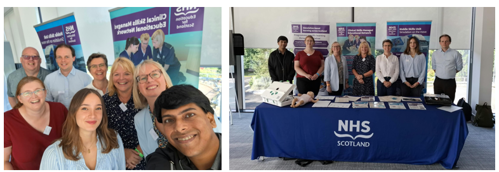
Scottish Simulation SIMposium 2026
Learning, Innovation and Collaboration Across Scotland
The Scottish Simulation SIMposium brought together educators, clinicians and simulation professionals from across Scotland to share ideas, explore innovation and strengthen connections within the simulation community. Members of the CSMEN team attended a range of workshops, keynote sessions and networking events, returning with valuable insights and practical ideas to enhance future educational delivery.
High-impact simulation does not need to be high-tech
One of the strongest themes from the SIMposium was that effective simulation is driven by clear learning objectives, thoughtful design and meaningful debriefing, rather than expensive equipment.
From visually enhanced mental simulation (VEMS) and tabletop exercises to sustainable moulage and multi-agency incident planning, presenters demonstrated how simple, scalable and creative approaches can deliver powerful learning experiences.
🔑 Top Themes from the SIMposium
🧠 1. VEMS: A Powerful Addition to the Simulation Toolkit
Visually Enhanced Mental Simulation (VEMS) was consistently highlighted as one of the most exciting and practical innovations showcased at the SIMposium.
Why it stood out:
✅ Low-cost and highly accessible
✅ Quick to set up in busy clinical environments
✅ Supports multi-professional team training
✅ Helps manage learner cognitive load
✅ Effective for algorithmic and decision-making scenarios
✅ Can be delivered in short, focused sessions
"Simulation does not need to be complicated to be effective."
🚑 2. Major Incident Planning: The Power of Partnership
A standout workshop explored a multi-agency paramedic major incident exercise that has grown from a student simulation to an event involving more than 600 participants from healthcare, emergency services, government and voluntary sectors.
Key lessons:
🟦 Start with the learning objectives and build everything around them.
🟦 Effective planning is essential regardless of whether there are 20 participants or 600.
🟦 Tabletop exercises improve preparedness and organisational buy-in.
🟦 The patient journey, risk assessment and safety considerations are critical.
🟦 Strong debriefing processes help turn learning into action.
For colleagues involved in major incident exercises, the session provided useful validation that many existing approaches already align with recognised best practice.
♻️ 3. Sustainability Through Creativity
One of the most talked-about practical sessions was the sustainable moulage showcasing innovative ways to create realistic injuries and training aids using:
🦴 Recycled simulation equipment
🏠 Everyday household materials
🩹 Repurposed anatomical models
💡 Simple, low-cost resources
The workshop demonstrated that realism can be achieved without significant expenditure while supporting sustainability goals.
"A huge lightbulb moment. I'll be keeping all of the old bones!"
🎓 4. Debriefing Matters
Several sessions reinforced that the real learning often happens after the simulation.
Key messages included:
🔹 Debrief systems as well as individuals
🔹 Ensure actions arising from debriefs have clear ownership
🔹 Treat pre-briefing as just as important as debriefing
🔹 Explore alternative approaches such as "shadow boxing" to discuss non-technical skills
Victoria Brazil's keynote challenged attendees to think about what happens after a simulation event:
"Who is responsible for implementing actions from the debrief?"
This prompted reflection on how organisations translate learning into meaningful system improvement.
🤝 5. Learning Through Collaboration and Networking
Networking remained one of the most valuable aspects of the SIMposium with the opportunity to:
- Share ideas and experiences
- Reconnect with colleagues across Scotland
- Build new professional relationships
- Learn from diverse sectors and specialties
The event reinforced the strength of Scotland's simulation community and the benefits of sharing knowledge across organisational boundaries.
🌍 6. Inclusive and Evidence-Based Education
Several sessions highlighted the importance of:
Being curious
Learning from International Medical Graduates and diverse learner groups rather than expecting everyone to fit the same model.
Measuring impact
Collecting evidence to demonstrate value and improve programmes over time.
Looking beyond healthcare
Adapting techniques from other industries, including gaming and alternative learning methodologies.
One message resonated strongly:
"Funding follows evidence."
⭐ Final Reflection
The Scottish Simulation SIMposium highlighted a vibrant and innovative simulation community committed to improving healthcare education through collaboration, creativity and evidence-based practice.
While technology continues to evolve, the strongest message was simple:
Great simulation is not defined by the sophistication of the equipment, but by the quality of the learning experience it creates.
Reflections and Learning from SESAM 2026

The Lothian Medical Education Directorate has generously shared insights, reflections, and key learning from the SESAM 2026 Conference in Lyon. Their summary captures the highlights, innovations, and practical takeaways from the event and we are delighted to share these with members of the CSMEN network.
Reflections and Learning from SESAM 2026 – Key takeaways for MED, Lothian
Translational simulation across Scotland
Translational simulation is "healthcare simulation focused directly on improving patient care and healthcare systems, through diagnosing safety and performance issues and delivering simulation-based intervention, irrespective of the location, modality or content of the simulation" as defined by Dr Victoria Brazil.
Explore how it is being implemented by different organisations and health boards across Scotland and its impact on the CSMEN Website.
Share your translational simulation work:
If you are undertaking translational simulation work across Scotland and are interested in raising awareness, sharing its impact, or fostering collaboration, we invite you to submit content for inclusion in our next newsletter.
Please email CSMEN@nes.scot.nhs.uk including a paragraph about the work, as well as the location it’s taking place and who to get in touch with for more information (pictures are also highly encouraged).
Mobile Skills Unit Update
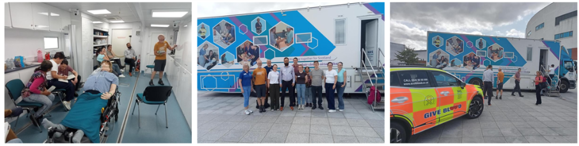
MSU on the Move: Faculty Development, Pre-Hospital Skills and a Major Incident Exercise
August has been another busy month for the Mobile Skills Unit (MSU), supporting healthcare professionals and multi-agency partners across Scotland.
The month began at Forth Valley Royal Hospital, where eight participants from across NHS Scotland took part in one of the two-day MSU Faculty Development Courses, developing their skills as simulation-based educators on the unit. Feedback from participants was excellent.
“A real eye opener into the potential and delivery of Simulation. Trainers are exceptional”
“Very useful course, lots of practical hands-on experience and good balance of slides and group work”
The MSU then returned to Cowal Community Hospital, working alongside BASICS Scotland to deliver three days of pre-hospital core skills training, covering emergencies in primary care, trauma and paediatrics.
Later in the month, the annual Western Isles tour gets underway with a return visit to the stunning Isle of Barra for the second multi-agency Major Incident Exercise. The exercise, involving emergency services, healthcare staff and local partners, will focus on pre-hospital emergency care, casualty extrication, communication and multi-agency coordination in a challenging remote environment.
Look out for next month's newsletter, where we'll share highlights and learning from the exercise, along with the impact of the MSU's latest visits across the Western Isles with tours from Barra to the Uist and Barra Hospital in Benbecula and finishing at the Western Isles Hospital in Stornoway.
Bringing high-quality simulation training closer to communities across Scotland, wherever it's needed most.
Thinking of booking the MSU for your region? Check the MSU’s calendar for available dates then complete a booking enquiry form and the MSU senior officer will get back in touch with you. For any MSU related queries, check our frequently asked questions page or email nes.msu@nhs.scot
Resources
Interprofessional Simulation for AHP practitioners
This resource developed by NHS GGC offers an accessible guide to postgraduate simulation training for Allied Health Professionals (AHPs), Dietitians, Occupational Therapists, Physiotherapists, and Speech and Language Therapists working at Practitioner Level (Level 5). It aims to provide a consistent framework that supports early‑career practitioners as they transition into their professional roles.
AHP Practitioner Interprofessional Simulation Handbook
Conferences
Conference details relevant to clinical skills and simulation are available on the CSMEN website.
Basics Scotland Update
Please refer to the BASICS Scotland website for all course dates.
SCSCHF Update
The TIES (Training for IMG Educational Supervisors) course aims to support trainers who are supervising new International Medical Graduates (IMGs) or may be in the future.
SCSCHF use immersive sim to explore challenging areas of supervision, intercultural working and support trainers in their role.
TIES has been designed to build on the resources currently available for the educational supervisors of new IMG doctors.
For further information or to book your place please visit the SCSCHF website
DIHS Update
Please refer to DIHS website for all course dates.