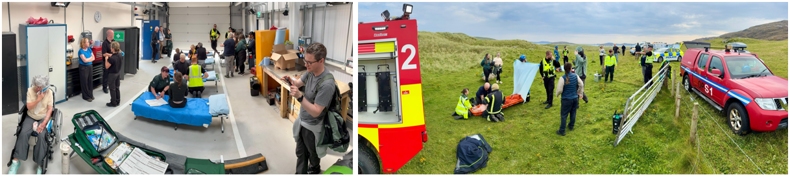
Building on the success of last year’s first Barra & Vatersay Major Incident Exercise the team came together again for a second major incident exercise named Operation Compton held on 27 August at Traigh Eais Beach (opposite Barra Airport). Planning began six months ahead of the exercise to coincide with the annual PSD Scotland Mobile Skills Unit visit to Barra.
A challenging scenario
The exercise centred on a simulated collision between a jet ski carrying a mother and daughter and a small cabin cruiser carrying four elderly occupants.
Key clinical challenges:
-
Burns and smoke inhalation
-
Trauma injuries
-
Drowning/near-drowning
-
Casualty extrication from a remote beach environment
-
Multi-agency incident management
-
Ongoing clinical treatment and transfer of patients
Training objectives
-
Pre-hospital emergency care
-
Multi-agency coordination and communication
-
Casualty extrication in challenging terrain
-
Use of off-road response capabilities
-
Clinical decision-making and patient transfer
Emergency responders adopted a structured approach using METHANE and the CSCATTT scene management frameworks. Extricating casualties from the beach scene to a triage area for assessment before onward transfer to hospital. Culminating in the HM Coastguard Search and Rescue helicopter arriving on scene to retrieve the critically ill patients.
Putting learning into practice
The Mobile Skills Unit played a key role in preparing participants for the exercise and providing opportunities to consolidate learning afterwards.
Pre-exercise training included EMRS-led sessions on burns and drowning, alongside surgical airway management, Ten Second Triage and major incident management.
Following the exercise, the MSU was also used to continue the simulated treatment of critically unwell patients.
This approach enabled participants to develop and refresh important clinical skills before putting them into practice within a complex, realistic scenario.
Working together
A major aim of Operation Compton was to strengthen the relationships and communication needed when responding to a real emergency in a remote island community.
Participants included colleagues from:
-
Barra Airport HIAL fire crews
-
HM Coastguard
-
Police Scotland
-
St Brendan’s Hospital
-
Scottish Ambulance Service
-
Pupils from Castlebay Community School participated as observers
Bringing healthcare and emergency services together provided an opportunity not only to practise individual skills, but to test how teams communicate, co-ordinate resources and work collectively when faced with a major incident.
Despite the voracious Western Isles midges, participants survived the day and came away with a wealth of learning and experience.
“We can do this”
For Dr Eleanor Barkell, GP at Clach Mhile Surgery, Barra Medical Practice and the local host for the MSU, the impact of the visit extends far beyond the exercise itself.
“The annual visit of the skills bus to the Isle of Barra is the cornerstone for healthcare education and team building. With the support of the team, we have organised two very successful multi-disciplinary major incident simulations.”
Barra and Vatersay are the most southerly inhabited islands in the Western Isles, with a combined population of approximately 1,300. Their remote geography, transport links and limited local healthcare resources make effective teamwork and collaboration between services particularly important.
Dr Barkell explained that the MSU visit provides a valuable focal point for both learning and relationship building, offering training not only to NHS staff but also opportunities for colleagues across the emergency services to learn together.
Reflecting on the two major incident exercises, she said:
“The impact of the two exercises has been huge and unquantifiable. The skills bus week provides a focal point for not only training but team working. We have tested our resources and resilience.”
She added:
“There has always been a can-do attitude amongst the islanders, but this has been highlighted by such events. The MSU team bring their expertise, knowledge and sense of humour and enable all the pieces to fit together. ‘We can do this’ is the phrase that I hear repeatedly as a result of the simulation.”
For the wider community, the training also demonstrates that geographical distance does not mean being overlooked when it comes to opportunities to develop skills, confidence and preparedness.
“The wider community is also extremely grateful that they have not been forgotten about. I cannot thank the team enough for the huge effort they put in.”
Thank you
Operation Compton was made possible by the enthusiasm, expertise and commitment of everyone involved, from those undertaking the exercise to the faculty members supporting its planning and delivery.
Faculty included Dr Eleanor Barkell (GP), Dr David Stoddart (EMRS Consultant), Dr Arvid Schigt (Trauma Lead, NHS Western Isles), Sema Deniz (EMRS Advanced Retrieval Practitioner), Susie James (Firefighter), Dr Leona Houston (University of Dundee), Andrea Baker (CSMEN Senior Manager) and Lynn Hardie (Mobile Skills Unit Senior Officer).
A huge thank you to everyone who contributed to another successful exercise and to the teams on Barra and Vatersay for demonstrating what can be achieved through collaborative, locally focused simulation and training.